
Following segmentation of the mesoderm, the lateral mesoderm splits into a somatic and a splanchnic layer associated with ectoderm and entoderm, respectively (Fig. 6.35). The muscles of the anterior abdominal wall are derived from the somatopleuric mesoderm and retain their segmental innervation from the anterior rami of the spinal nerves.
Unlike the thorax, the segmental arrangement becomes lost because of the absence of ribs, and the mesenchyme fuses to form large sheets of muscle. The rectus abdominis retains indications of its segmental origin, as seen by the presence of the tendinous intersections. The somatopleuric mesoderm splits tangentially into three layers, which form the external oblique, internal oblique, and transversus abdominis muscles.
The anterior body wall finally closes in the midline at 3 months, when the right and left sides meet in the midline and fuse. The line of fusion of the mesenchyme forms the linea alba, and on either side of this, the rectus muscles come to lie within their rectus sheaths.
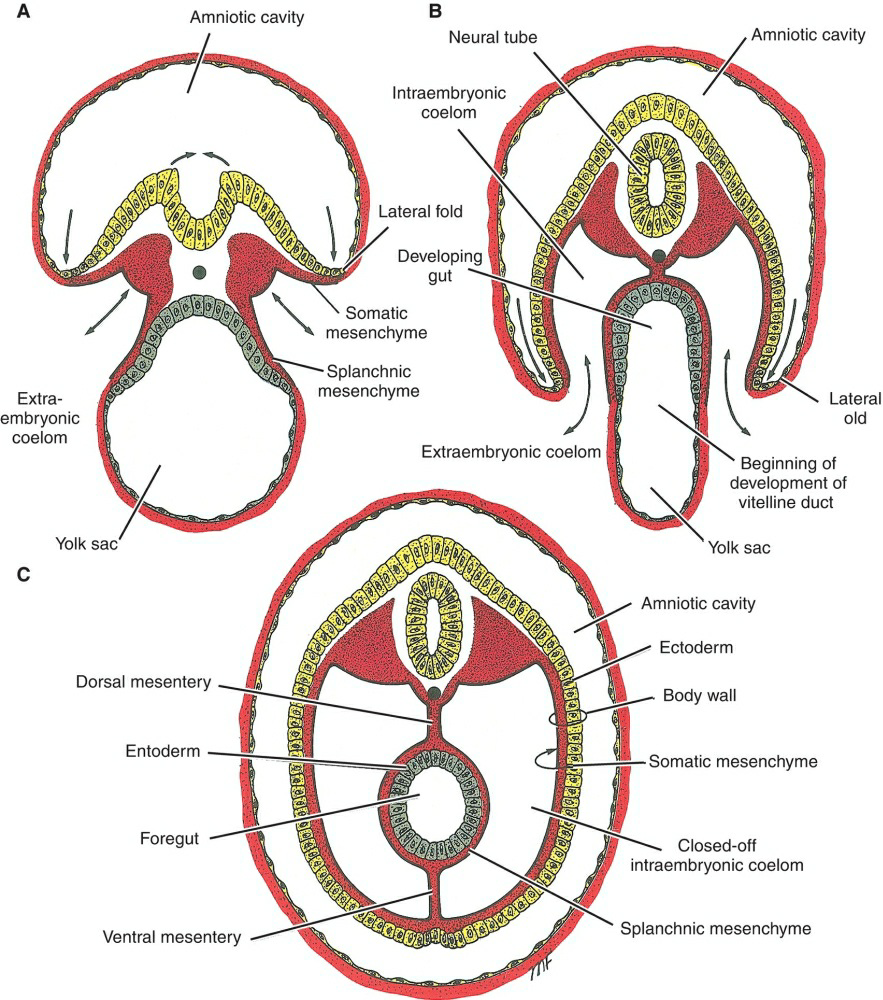
Figure 6.35 Transverse sections through the embryo at different stages of development showing the formation of the abdominal wall and peritoneal cavity.
A. The intraembryonic coelom in free communication with the extraembryonic coelom (double-headed arrows).
B. The development of the lateral folds of the embryo and the beginning of the closing off of the intr aembryonic coelom.
C. The lateral folds of the embryo finally fused in the midline and closing off the intraembryonic coelom or future peritoneal cavity. Most of the ventral mesentery will break down and disappear.
Umbilical Cord and Umbilicus Development
As the tail fold of the embryo develops, the embryonic attachment of the body stalk to the caudal end of the embryonic disc comes to lie on the anterior surface of the embryo, close to the remains of the yolk sac (Fig.6.36). The amnion and chorion now fuse, so that the amnion encloses the body stalk and the yolk sac with their blood vessels to form the tubular umbilical cord. The mesenchymal core of the cord forms the loose connective tissue called Wharton’s jelly.
The remains of the yolk sac, the vitelline duct, the remains of the allantois, and the umbilical blood vessels are embedded in this. The umbilical vessels consist of two arteries that carry deoxygenated blood from the fetus to the chorion (later the placenta). The two umbilical veins convey oxygenated blood from the placenta to the fetus.
The right vein soon disappears (see Fig. 6.36). The umbilical cord is a twisted tortuous structure that measures about 0.75 in. (2 cm) in diameter. It increases in length until, at the end of pregnancy, it is about 20 in. (50 cm) long—that is, about the same length as the child.
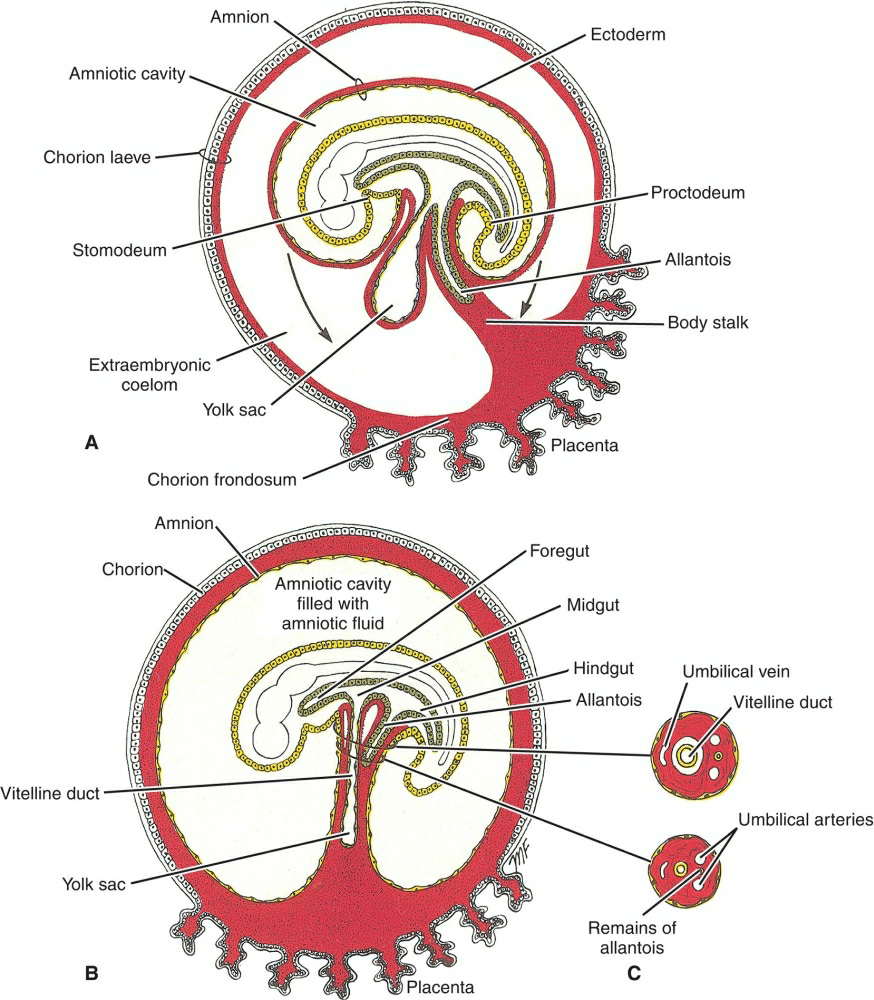
Figure 6.36 The formation of the umbilical cord.
A. Early formation.
B. Later formation. Note the expansion of the amniotic cavity (arrows) so that the cord becomes covered with amnion.
C. Note that the umbilical vessels reduce to one vein and two arteries.