
The diaphragm is formed from the following structures:
(a) the septumtransversum, which forms the muscle and central tendon;
(b) the two pleuroperitoneal membranes, which are largely responsible for the peripheral areas of the diaphragmatic pleura and peritoneum that cover its upper and lower surfaces, respectively; and
(c) the dorsal mesentery of the esophagus, in which the crura develop.
The septum transversum is a mass of mesoderm that is formed in the neck by the fusion of the myotomes of the third, fourth, and fifth cervical segments. With the descent of the heart from the neck to the thorax, the septum is pushed caudally, pulling its nerve supply with it. Thus, cervical nerves C3 to 5 form the phrenic nerve, which supplies the diaphragm.
The pleuroperitoneal membranes grow medially from the body wall on each side until they fuse with the septum transversum anterior to the esophagus and with the dorsal mesentery posterior to the esophagus. During the process of fusion, the mesoderm of the septum transversum extends into the other parts, forming all the musculature of the diaphragm. The motor nerve supply to the entire muscle of the diaphragm is the phrenic nerve.
The central pleura on the upper surface of the diaphragm and the peritoneum on the lower surface are also formed from the septumtransversum, which explains their sensory innervation from the phrenic nerve. The sensory innervation of the peripheral parts of the pleura and peritoneum covering the peripheral areas of the upper and lower surfaces of the diaphragm is from the lower six thoracic nerves. This is understandable, because the peripheral pleura and peritoneum from the pleuroperitoneal membranes are derived from the body wall.
Diaphragmatic Herniae
Congenital herniae occur as the result of incomplete fusion of the septumtransversum, the dorsal mesentery, and the pleuroperitoneal membranesfrom the body wall.
The herniae occur at the following sites:
(a) the pleuroperitoneal canal (more common on the left side; caused by failure of fusion of the septum transversum with the pleuroperitoneal membrane),
(b)the opening between the xiphoid and costal origins of the diaphragm, and
(c) the esophageal hiatus.
Acquired herniae may occur in middle-aged people with weak musculature around the esophageal opening in the diaphragm. These herniae may be either sliding (hiatal) or paraoesophageal (Fig. 4.12).
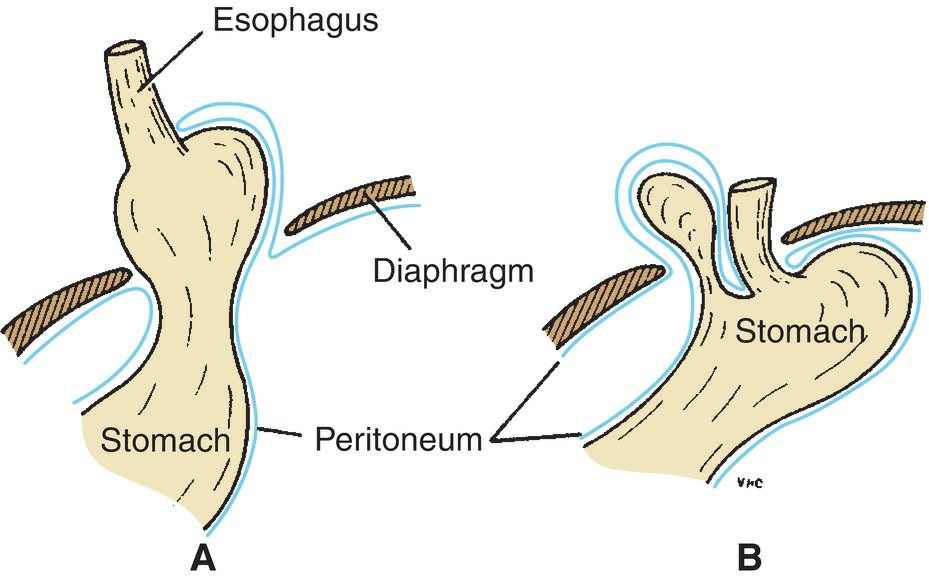
Figure 4.12 A. Sliding esophageal hernia. B. Paraoesophageal hernia.