
longitudinal groove, the laryngotracheal groove, develops in the endodermal lining of the floor of the pharynx. This gives rise to the laryngotracheal tube (respiratory diverticulum, lung bud) (Fig. 5.25).
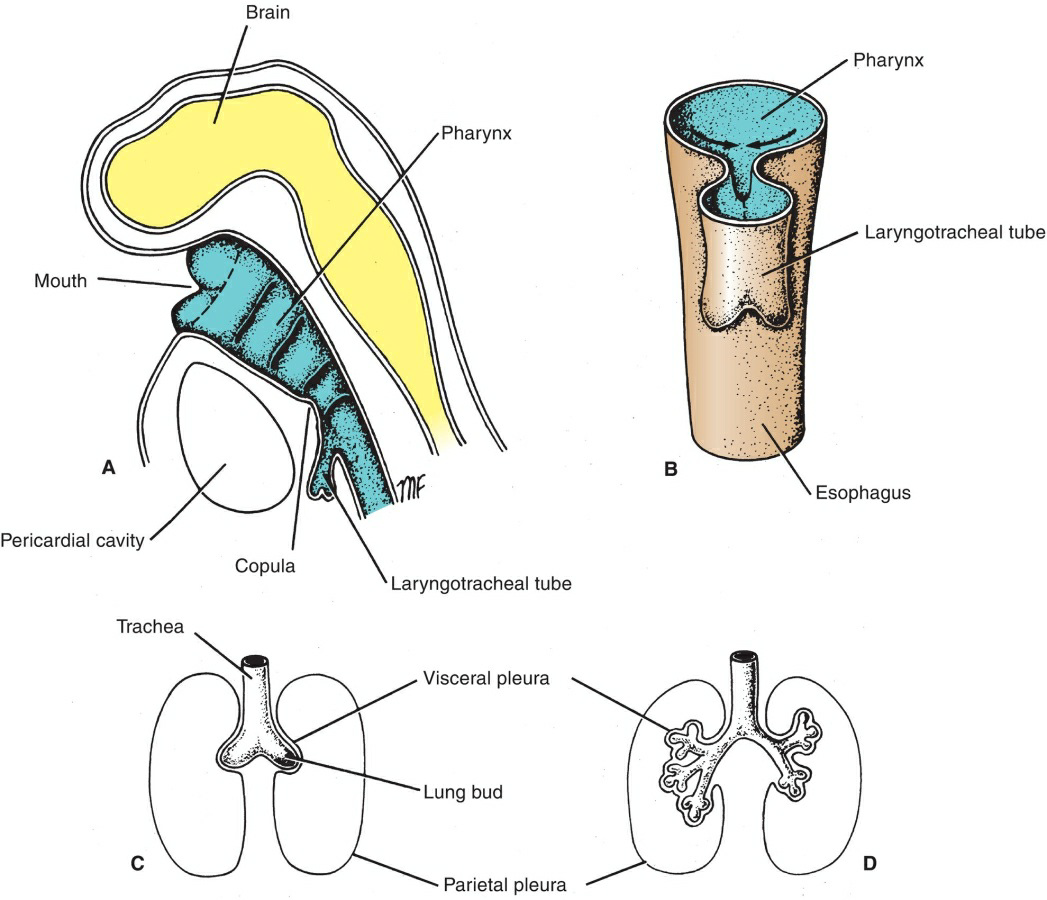
Figure 5.25 The development of the lungs. A. The laryngotracheal groove and tube have been formed. B. The margins of the laryngotracheal groove fuse to form the laryngotracheal tube. C. The lung buds invaginate the wall of the intraembryonic coelom. D. The lung buds divide to form the main bronchi.
A tracheoesophageal septum partitions the laryngotracheal tube from the foregut, forming two structures: a more dorsal esophagus and a more ventral (anterior) respiratory primordium. The laryngotracheal tube grows caudally into the splanchnic mesoderm and divides distally into the right and left lung buds.
Cartilage develops in the mesenchyme surrounding the tube, and the upper part of the tube becomes the larynx, whereas the lower part becomes the trachea. Each lung bud consists of an endodermal tube surrounded by splanchnic mesoderm; all the tissues of the corresponding lung are derived from this.
Each bud grows laterally and projects into the pleural part of the embryonic coelom (see Figs. 5.4 and 5.25). The lung bud divides into two or three lobes, corresponding to the number of main bronchi and lobes found in the fully developed lung.
Each main bronchus then divides repeatedly in a dichotomous manner, until eventually the terminal bronchioles and alveoli form. The division of the terminal bronchioles, with the formation of additional bronchioles and alveoli, continues for some time after birth.
Splanchnic mesoderm forms the visceral pleura, whereas somatic mesoderm forms the parietal pleura. By the 7th month, the capillary loops connected with the pulmonary circulation are sufficiently well developed to support life, should premature birth take place. With the onset of respiration at birth, the lungs expand and the alveoli dilate. However, the alveoli in the periphery of each lung become fully expanded only after 3 or 4 days of postnatal life.