
Once the lateral mesoderm has split into somatic and splanchnic layers, a cavity is formed between the two, called the intra embryonic coelom. The peritoneal cavity is derived from that part of the embryonic coelom situated caudal to the septum transversum. In the earliest stages, the peritoneal cavity is in free communication with the extra embryonic coelom on each side (see Fig. 6.35 B).
Later, with the development of the head, tail, and lateral folds of the embryo, this wide area of communication becomes restricted to the small area within the umbilical cord.
Early in development, the peritoneal cavity is divided into right and left halves by a central partition formed by the dorsal mesentery, the gut, and the small ventral mesentery (Fig. 7.18 A). However, the ventral mesentery extends only for a short distance along the gut, so that below this level, the right and left halves of the peritoneal cavity are in free communication (see Fig. 7.18 B).
As a result of the enormous growth of the liver and the enlargement of the developing kidneys, the capacity of the abdominal cavity becomes greatly reduced at about the 6th week of development. At this time, the small remaining communication between the peritoneal cavity and extra embryonic coelom becomes important.
An intestinal loop is forced out of the abdominal cavity through the umbilicus into the umbilical cord. This physiologic herniation of the midgut takes place during the 6th week of development.
Peritoneal Ligaments and Mesenteries Formation
The peritoneal ligaments are developed from the ventral and dorsal mesenteries. The ventral mesentery is formed from the mesoderm of the septum transversum (derived from the cervical somites, which migrate downward). The ventral mesentery forms the falciform ligament, the lesser omentum, and the coronary and triangular ligaments of the liver (see Fig.7.18C, D).
The dorsal mesentery is formed from the fusion of the splanchnopleuric mesoderm on the two sides of the embryo. It extends from the posterior abdominal wall to the posterior border of the abdominal part of the gut (Figs. 6.35 and 7.18A, B).
The dorsal mesentery forms the gastrophrenic ligament, the gastrosplenic omentum, the splenorenal ligament, the greater omentum, and the mesenteries of the small and large intestines.
Lesser and Greater Peritoneal Sac Formation
The extensive growth of the right lobe of the liver pulls the ventral mesentery to the right and causes rotation of the stomach and duodenum(Fig. 7.19A, B). By this means, the upper right part of the peritoneal cavity becomes incorporated into the lesser sac. The right free border of the ventral mesentery becomes the right border of the lesser omentum and the anterior boundary of the entrance into the lesser sac.
The remaining part of the peritoneal cavity, which is not included in the lesser sac, is called the greater sac, and the two sacs are in communication through the epiploic foramen.
Greater Omentum Formation
The spleen is developed in the upper part of the dorsal mesentery, and the greater omentum is formed as a result of the rapid and extensive growth of the dorsal mesentery caudal to the spleen. To begin with, the greater omentum extends from the greater curvature of the stomach to the posterior abdominal wall superior to the transverse mesocolon. With continued growth, it reaches inferiorly as an apron-like double layer of peritoneum anterior to the transverse colon (see Fig. 7.19 C).
Later, the posterior layer of the omentum fuses with the transverse mesocolon. As a result, the greater omentum becomes attached to the anterior surface of the transverse colon (see Fig. 7.19 D). As development proceeds, the omentum becomes laden with fat. The inferior recess of the lesser sac extends inferiorly between the anterior and the posterior layers of the fold of the greater omentum.
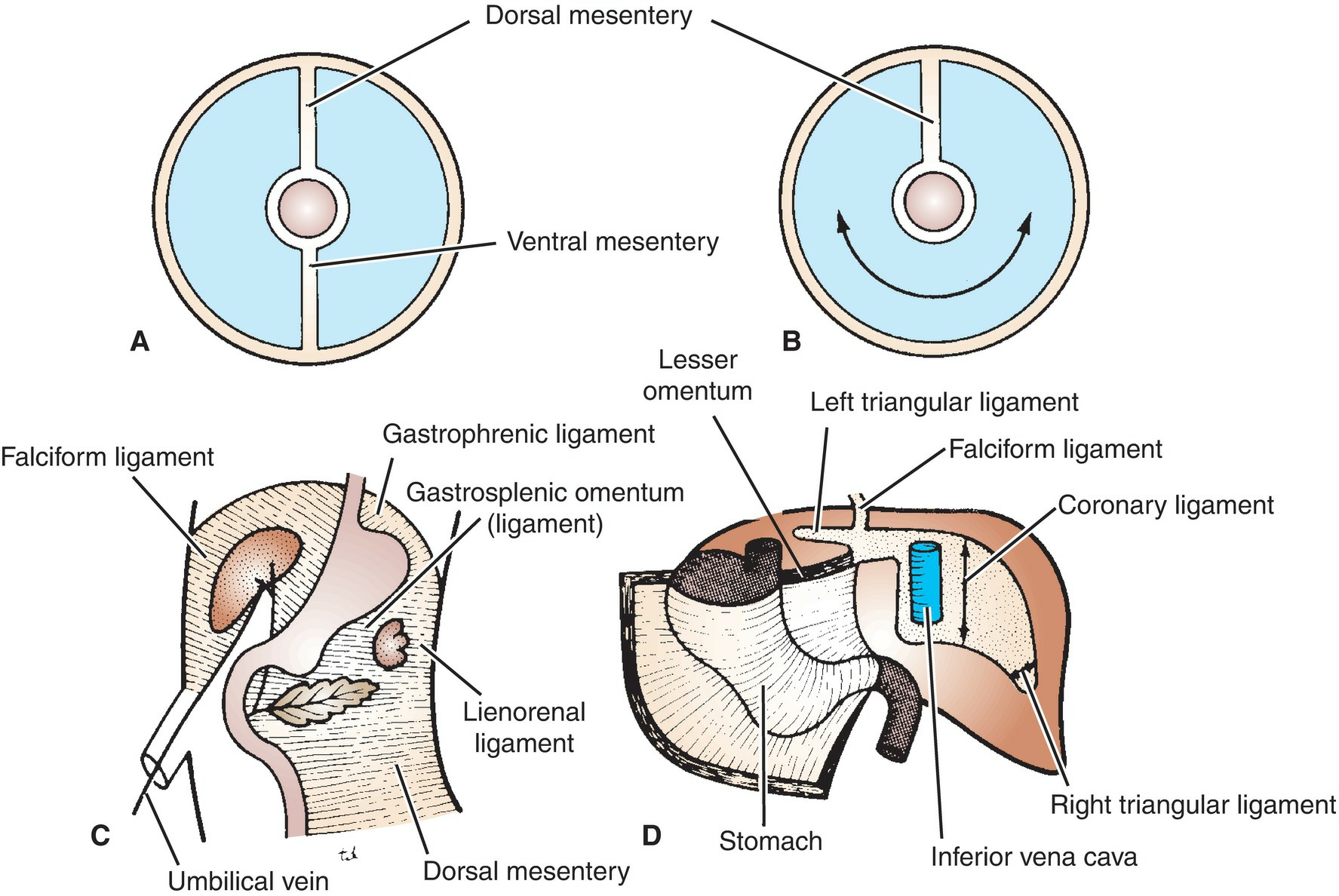
Figure 7.18 Ventral and dorsal mesenteries and the organs that develop within them.
A. Both ventral and dorsal mesenteries occur in the upper abdomen.
B. No ventral mesentery in the lower abdomen, thus allowing free communication between both sides of the peritoneal cavity.
C. Sagittal view showing ventral and dorsal mesenteries.
D. Posterior view showing derivatives of the ventral mesentery.
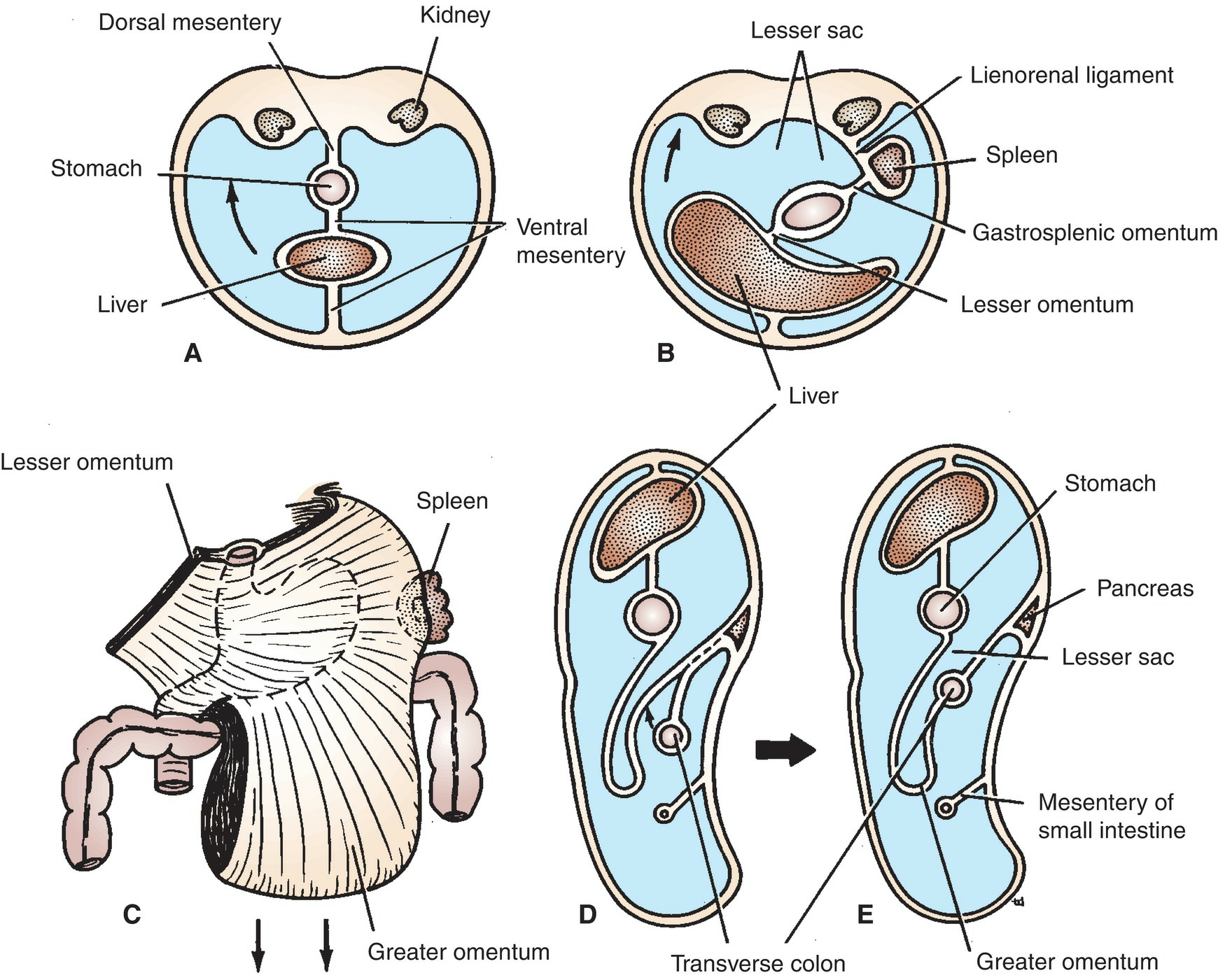
Figure 7.19 The rotation of the stomach and the formation of the greater omentum and lesser sac.
A. Horizontal section showing both ventral and dorsal mesenteries. B. Rotation of the stomach and liver and formation of the lesser sac. C. Anterior view showing growth of the greater omentum (arrows). D, E. Sagittal sections showing final steps in formation of the greater omentum.